
How to Identify Parts of a Speaker
Have you ever peeked inside your speakers and wondered what all those different parts are called? Knowing the components that make up your speaker system empowers you to understand better how they work and what to look for when repairs are needed.
Here at The Speaker Exchange, we want to help you better understand speaker parts and how to identify them, with or without a diagram. Read on as we demystify speaker anatomy 101.
If you are familiar with each component, you can assure optimal performance and handle issues more easily. Understanding the function of every part facilitates making educated judgments while upgrading or replacing speaker pieces. With this knowledge, you’ll be in a better position to preserve and improve your audio experience.
How Does a Speaker Work?
Can You Over & Undervolt a Speaker?
Providing a speaker with too much or too little power can cause problems. Sending an overpowered audio signal to the voice coil will overheat it, potentially leading to failure. Likewise, underpowering speakers prevents them from reaching their full potential sound quality.
Matching your amplifier’s wattage to your speakers’ ratings keeps things running smoothly. Exceeding power handling limits frequently leads to the need for recone kits or refoam kits down the road.
Now that you can talk speaker parts like a pro, you’re ready to evaluate your systems and determine if any replacement components are in order. Understanding speaker anatomy is the first step to keeping your music sounding its best. One of the best ways to do so is to look at a diagram. You can look at our website to find a diagram that better illustrates where speaker parts are, how to find them, and even a diagram on how to access the parts.
The Speaker Exchange has all the information you need to identify the parts in your speaker systems. From cones & coils to magnets & frames, discover the components that make up your speakers & how to recognize them. Visit our website and contact us today.

What Components Make up A Speaker?
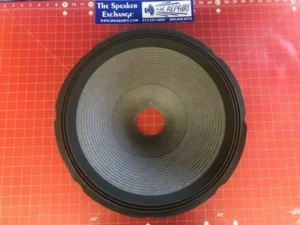
The Cone
Also called the diaphragm, the cone is the large surface that physically moves to create sound waves. Paper, polypropylene, kevlar, and other materials give cones distinctive properties.
These parts affect the cone’s sensitivity, longevity, and overall sound quality. The cone’s construction and form also influence the precision and dispersion of the sound produced.

The Surround
The flexible surround (sometimes called the suspension) connects the cone to the speaker frame. It commonly consists of foam, rubber, cloth or paper.
The surround ensures precise sound reproduction by allowing the cone to move freely while keeping its alignment. The material selection impacts the speaker’s overall performance, flexibility, and durability.

The Voice Coil
This wire coil sits in the magnetic gap and carries audio signals from the amplifier. Voice coils are characterized by their wire gauge, number of windings, and resistance.
The voice coil’s interaction with the magnetic field produces the motion required to move the cone and produce sound waves. The wire gauge and number of windings are two design criteria that affect the frequency response and efficiency of the speaker.
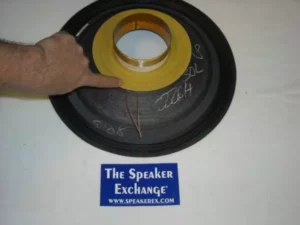
The Spider
Like the surround, the spider holds the voice coil in proper alignment within the magnet gap. Depending on their design, spiders can be “soft” or stiff.
The spider maintains the voice coil’s centering and steady movement for correct sound reproduction. Bass extension and power handling are just two examples of how flexibility or stiffness affects the speaker’s overall response and performance.
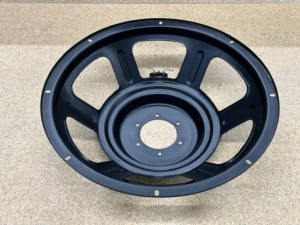
The Frame
Also called the basket, the frame provides an important structural foundation for the speaker. Key measurements like mounting depth are based on the frame dimensions.
The frame supports all of the speaker’s other parts, guaranteeing stability and longevity. The speaker’s material and design also influence its overall acoustic performance and resonance.

Burnt Voice Coil
A Burnt Voice Coil is when the windings are overpowered, unraveled, or open which means there is a break in the windings or connection to the pigtails.
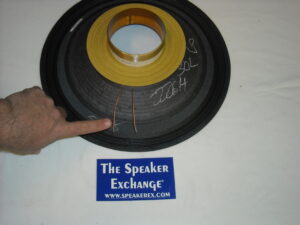
Pigtail or Lead Wires

The Terminal

The Dustcap
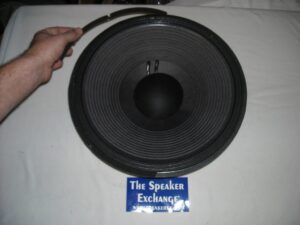
The Gasket
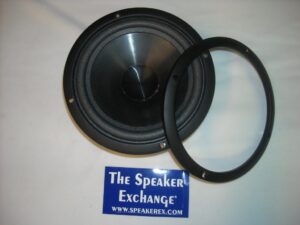
The Beauty Cover
Domestic Shipping Options:
USPS (United States Post Office)
USPS Ground Advantage: 2-7 day estimated* delivery time. Limited tracking information
UPS (United Parcel Service)
UPS Ground: 1-6 day delivery time, depending on destination. Detailed tracking information provided.
UPS Expedited Services are as stated; 3 Day Select: Delivery within three business days. 2nd Day Air: Delivery within two business days. Next Day Air Saver: Delivery next business day. Detailed tracking provided for all.
*The above transit times are estimated only.
**All shipments are fully insured in case of damage or loss.
International Shipping Options:
USPS (United States Post Office)
USPS First Class International: 1-4 week delivery time. Limited tracking information.
USPS Priority International: 1-2 week estimated* delivery to customs with tracking information provided.
USPS Priority Express International: 3-5 business days estimated* to customs with tracking information provided.
UPS (United Parcel Service)
UPS Worldwide Expedited: 2-5 days to most countries, door to door. UPS has its own customs which speeds up delivery. Detailed tracking information provided.
UPS Worldwide Saver: 1-3 days to most countries, door to door. UPS has its own customs which speeds up delivery. Detailed tracking information provided.
*The above transit times are estimated only.
**All shipments are fully insured in case of damage or loss