How to diy recone with unassembled parts
Recone Instructions
These instructions are generic to most brands. Some recone kits come with the voice coil alreadyattached to spider. Some come as a voice coil/spider/cone assembly. In addition, you may need tomodify parts as required for specific driver models and brands.
It is important to read the complete instructions before starting your repair.
Remove speaker parts:
Use a utility knife and cut the cone and spider (slicing through the pigtails- also known as lead wire orbraided wire) near the speaker frame. Remove the recone kit assembly. Immediately cover thevoice coil gap with masking tape. Use the utility knife to clean the remaining spider from the frame.Remove the gasket; it can be reused if a new matching gasket is not available. Clean the remainingglue, surround, and gasket debris from the frame. De-solder the pigtail leads and clean the terminal.(See “How To Clean A Speaker” instructions under Reconing FAQ) There are also videos forcleaning and reconing in that section.
*** Dry fit all the parts together in the frame to insure they fit before using any adhesives! ***
Installing the Voice-Coil Assembly:
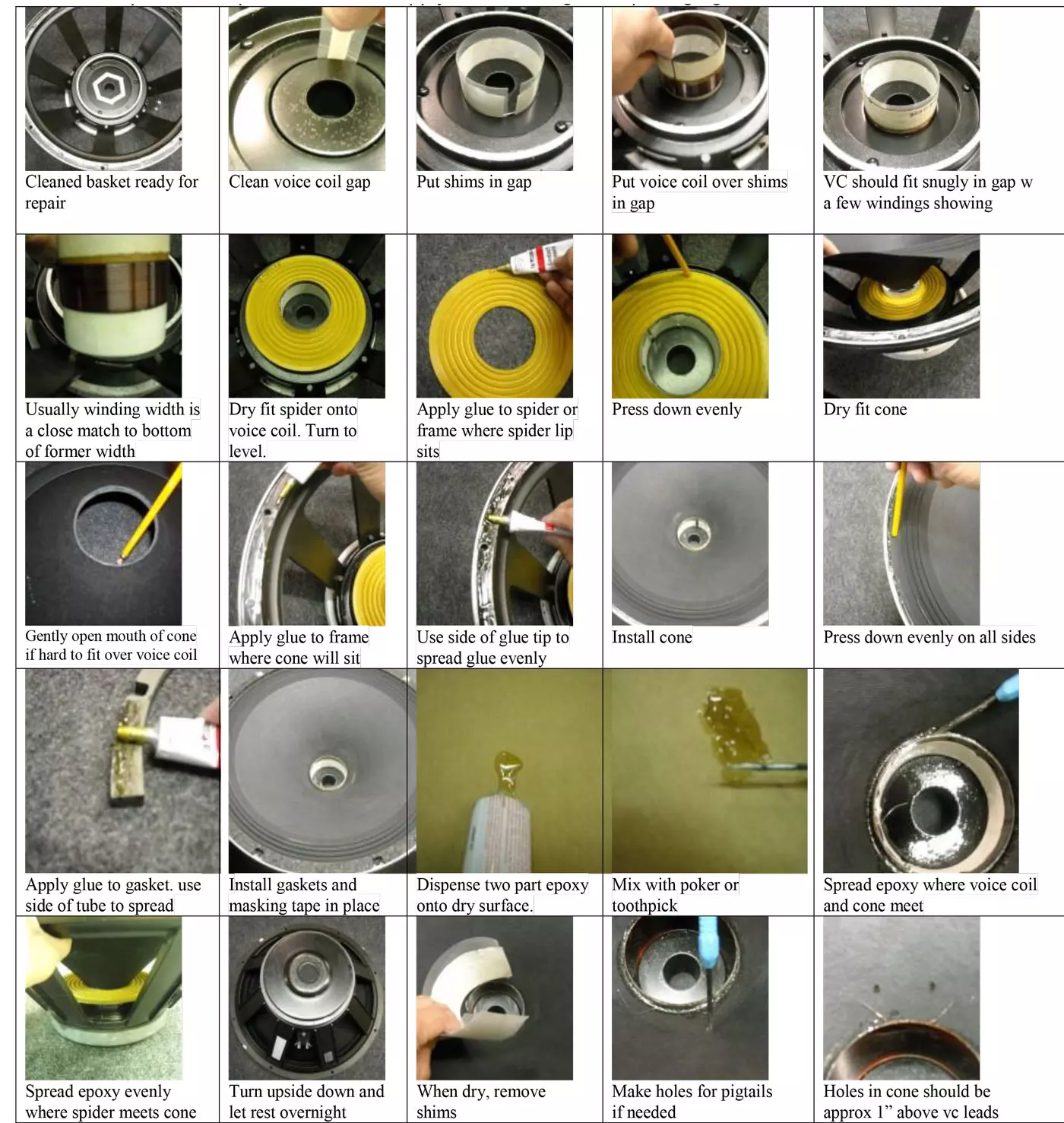
Clean all the debris from inside the speaker frame and magnet. Use compressed air (if available) toblow debris from the speaker and eventually from the voice coil gap. Add another layer of maskingtape over the first to trap any remaining debris. Keeping both layers of the masking tape together,remove from the voice coil gap. Inspect the voice-coil gap. Clean the gap thoroughly by foldingmasking tape over a shim so the sticky side is exposed on both sides (sticky side facing out- seepicture #2). Insert into the gap and circle. Repeat with new tape continually until the tape remainsclean. If the original voice coil was burnt, check for loose windings in the gap.
Install the voice coil into the gap combining different color shims on the inside of the voice coil untilyou get a tight fit and the coil won’t move easily. The shims should not overlap one another (theyshouldn’t be more than 360*). You must check to make sure there is clearance on the outside of thevoice coil by inserting a thin shim into the gap between the outside of the voice coil windings and themagnet. The shim should easily move around the outside of the voice coil without any obstruction.Inspect to see that the voice coil is set evenly by viewing it from the side. You should be able to seean even amount of the windings from all sides. The height of the coil is determined by the travel of thecone and length of former and windings. Inspect the original parts for a guideline. A general rule ofthumb is to set the coil so that the distance from the bottom of the shims matches the length of thewindings. Ideally, the top two windings of the voice coil wind should be visible above the top plate ofthe magnet. * This is not true for all speakers. * Holding the voice coil and shims with your thumband forefinger on each side of the voice coil, pull the shim(s) and voice coil out so you can comparethe space on the shims to the bottom of the magnet (see the picture #6 below). There should be thesame distance of the wind width between the bottom of the voice coil and the bottom of the magnet.For example, if the voice coil windings are .500” then you would want about .500” between the bottomof the voice coil and the bottom of the magnet. If the recone kit has a large travel cone (foam or butylsurround), then set the voice coil slightly higher. Remember that if you set the voice coil too low, thecoil will “bottom-out”. If you set it too high, the coil may come out of the magnet’s gap and can bedamaged or bent. Install the voice coil leads so they align with the terminal on the frame. Gently placethe leads over top of shim so they will not be in the way when you install the spider and cone.
Install the spider:
Taking care not to move the voice coil leads, dry fit the spider over the voice coil and lower it on to theframe. Turn the spider gently to insure it is sitting evenly. Remove the spider and apply a bead ofcontact glue to the landing on the speaker’s frame. Install the spider on the frame and gently turn it toinsure proper seating. If it is a flat spider press the spider to the frame at the landing in a full circle toinsure the glue attaches to the outside of the spider fully. If it is a cup spider a small amount ofcontact glue can be applied around the point where the spider meets the frame to insure the spiderattaches properly.
Install the cone:
Taking care not to move the voice coil leads, dry fit the cone over the voice coil. If the opening isslightly too small, gently open it with the back of your thumb nail or a pen. If it is much too small, thenuse the voice coil as a template, outline the correct size on the cone, and open the cone with astraight edge razor blade. Then smooth it with your thumb nail.
Check if the cone throat opening reaches the spider. If the cone reaches the spider, then remove thecone and apply contact glue to the landing where the cone attaches to the frame. Press the cone’sedge into the glue on the frame. Use contact glue to install the gasket. Use small pieces of maskingtape to hold the gasket in place. Apply a bead of epoxy to attach the cone to the coil making sure thatepoxy reaches the spider completely. You may need to slightly lift and lower the cone so the epoxyforms a bead where the spider attaches to the voice coil but take care to keep the epoxy off theshims. If needed, you can smooth the epoxy where it meets the voice coil with a solder poker tool oranother thin tool.
If the cone does not reach the spider, epoxy the spider to the voice coil and then install the cone andgasket. Add a separate bead of epoxy to the cone where it meets the voice coil. There will be noneed to move the cone up and down. If needed, you can smooth the epoxy where it meets the voicecoil with a solder poker tool or another thin tool.
To insure that the epoxy does not drip into the voice coil gap, turn the speaker upside down on a flatsurface (careful to not shift the gaskets). Let it dry for 18 to 24 hours. If the cone has a foam or rubbersurround and the surround is higher than the gasket, you must use a spacer under the speakergasket so the surround is not crushed and the entire assembly is not pushed upward when thespeaker is turned upside down. The next day, gently move the voice coil’s leads out of the way andremove the shim(s).
Wiring and installing the dust cap:
Dry fit the dust cap to the cone. The voice coil should not touch the dustcap. If the voice coil former istoo tall it needs to be trimmed. If this is necessary, gently cut the paper on either side of the voice coilleads on the former. Gently pull the paper slits down and then gently pull down the leads. Using astraight edge or clippers, you can now trim the top of the voice coil to the desired height so the dustcap will fit without touching the former. This procedure is only necessary if the dust cap is too tall forthe dust cap to fit correctly.
Install the pigtails through the eyelets on the cone. If no eyelets exist, use a screw to poke holes inthe cone for the pigtails. Bend the voice coil leads down the former and up the cone. It should lay flaton both surfaces. Wrap the voice coil leads around the pigtails a few times and solder them togetherthen trim the excess pigtail. Solder the other end of the pigtails to the terminals or lugs on the frameleaving “arches” that allow the cone to have full range of excursion (be careful not to make the archtoo long or too short). Make sure the leads face away (outward) from one another so they cannotshort each other out. Clip the excess pigtail from the outside of the terminals. Using contact glue,adhere the voice coil lead wires to the cone and let dry. When dry, hold the speaker facing downward(so debris cannot fall into the voice coil gap) and test the speaker. If it’s noisy, try to clean inside thevoice coil gap by gently inserting masking tape in between the voice coil and the center pole piecewith the sticky side of the tape facing inward, circle and remove any excess debris. Install the dustcap. If the dust cap has a lip on it apply glue to the lip and place it on cone. If there is no lip, install thedust cap and add a bead of glue to where the cap meets the cone. A light weight can be put on thedust cap to hold in place as it dries. Apply the cone edge dampening agent if needed.